Meet Sally. The best sales “person” you could ever hire.
She works your whole market like a great rep would — never spray and pray. She maps it, prioritizes it, watches it, moves at the right moment, reaches the right person by email, text, or phone, runs the sales call, and stays with the deal until it closes.
Hey —
If you’re running a B2B company, you probably know (at least roughly) who’d buy what you sell.
Maybe it’s 500 companies. Maybe it’s 5,000. Maybe it’s 50,000.
Whatever the number is, that’s your market.
And most sales software treats it like it’s disposable.
Upload a list. Enrich it. Put everyone in a sequence. Send five follow-ups. Burn through it. Get in front of everyone. Force ourselves onto them with our mail-merges. Find another list.
AI has made this worse. I see it in my inbox and I’m sure you do too.
Instead of AI giving every company the ability to cover a market intelligently, we used it to help everyone send more.
That’s nuts. Frankly, if you blast your market with low-quality outreach, you’re going to get a reputation — and it’s not a good one.
Others promise you meetings. Maybe they get them. Most of the time they don’t. But every B2B executive already knows the truth:
One sale beats 500 shitty meetings.
A great salesperson doesn’t look at 2,000 companies and ask:
How fast can I email all of these people?
They ask:
- Which companies look like good buyers? Not because I want them to be customers, but because they genuinely need what I’m selling?
- What happened the last time we talked?
- Why would they buy now?
- Who changed jobs?
- Who just hired?
- Whose contract is coming up?
- Who told us “not now” two years ago and is “now” actually right now?
And sometimes the right answer is:
Don’t contact them yet.
Just remember them. Watch them. And be there when something changes.
That’s what we built Sally to do.
Give Sally the companies you want to win.
She learns them. Prioritizes them. Works the ones worth working now. Watches the rest. Remembers every conversation, relationship, objection, and reason you lost.
When there’s a reason to move, she moves.
She can research the account, find the right person, know exactly what to say to them, write them, follow up, take the sales call, and keep the opportunity moving until you want to take over, or they’re closed-won.
We didn’t build another AI-powered spam cannon.
We built a salesperson who can keep your whole market in her head.
Forever.
If you’d rather win your market than burn through it, I think you’ll like Sally.
— Patrick
Founder, SallySells
She doesn’t just book the meeting. She takes it.
A buyer can go from an email reply to a live spoken sales call without finding time on a calendar.
Sally already knows the account, the thread, the product, and the conversation that got them there. No context lost. No no-show. No handoff at the moment interest is highest.
If the buyer wants pricing, she can discuss pricing. If they want technical detail, she can go there. If the CFO joins, she tailors the positioning. If they want a human, she gets you.
And the call isn’t only something the buyer clicks into. She picks up the phone, too — your own number, a tier-one account’s main line, their business hours — and answers when a prospect calls back. Same salesperson, same memory of the account, one more way in.
You decide where her job ends.
the book → the signal → outreach → the call → follow-up → the close
What follows is one account, start to finish.
Building the book
Reads everything you give her and everything public, builds the book with you, verifies every account, and tiers it before anybody is emailed.
The moment to move
She watches every account in the book, and she's been watching Harborlight for eleven months. This week, two things changed.
She'd been waiting eleven months for this.
One person. The right channel.
She has three ways to reach John: email from her own address on your domain, a text if he'd opted in, or a call to Harborlight's main line in their business hours. Tonight it's email — he's never given her a number, and a note carries a link he can act on at 11pm.
Written for John, about what just changed at Harborlight. An honesty check rejects name-swap templates and invented urgency.
John —
Congratulations on the VP title, and on Cedar Ridge. When we spoke in 2024 you said to come back after the Tucson lease-up — this looked like the moment.
340 more units is a lot of renewals to watch by hand. If I could tell you which residents were likely not to renew, eight weeks before they gave notice, would it be worth fifteen minutes?
Here's a link to our AI-powered sales presentation. She can walk you through why this matters in 15 min or less. No time on your calendar needed.
Sally
Live sales calls
Not a chatbot on a page. A spoken conversation, on the prospect's schedule, where they set the pace and can ask for a human at any point without repeating themselves. John replied at 11:02 on a Thursday night and clicked the link in her answer. No calendar. No “someone will be in touch.” No no-show, either — the call happens the moment the buyer wants it, which is how the fifth of booked meetings that ordinarily evaporate simply don't. The next voice he heard was Sally's. Watch what she does before he's pitched anything — and watch the deck keep up with him.
your
phone
Re: congratulations — and Cedar Ridge
Got fifteen minutes now if you do.
Perfect — this puts you straight through to me, no calendar:
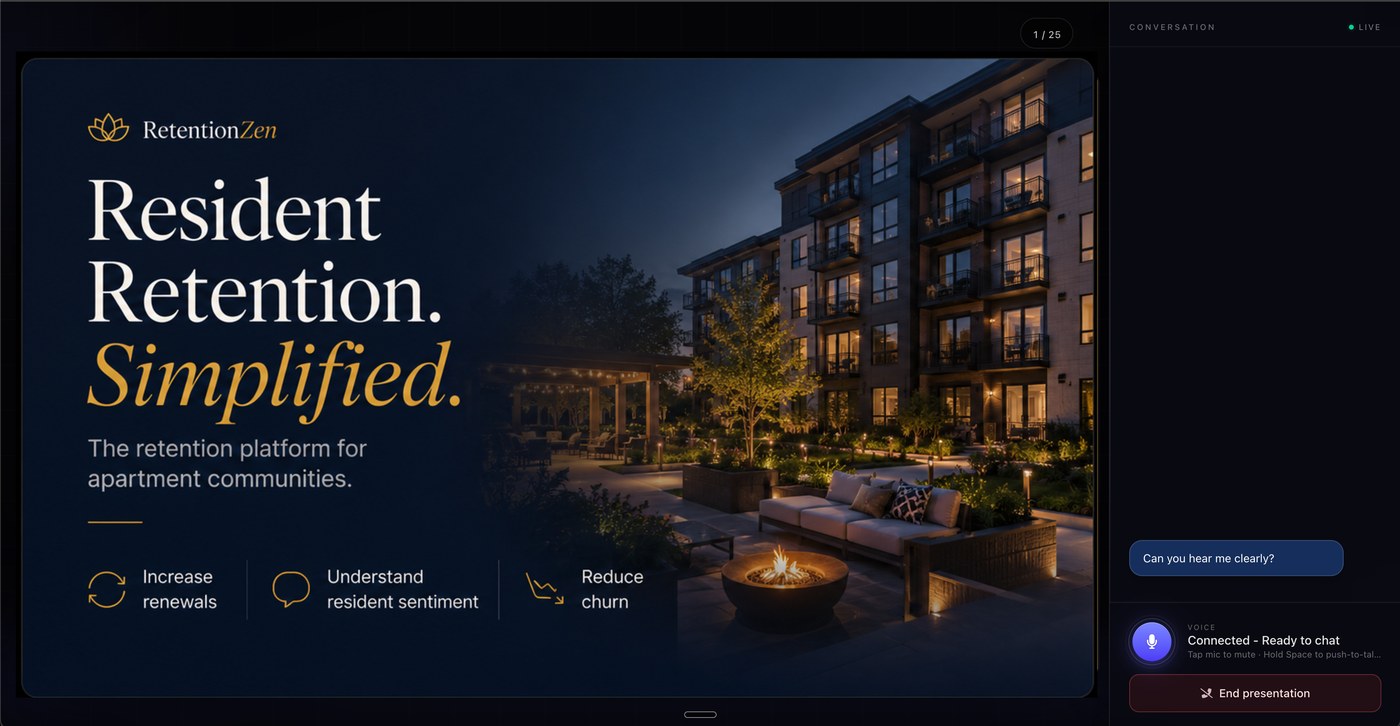
11:24 PM — a first conversation, a committed next step, every objection captured on the deal, and nobody on their team awake for any of it.
Follow-up and qualification
She tracks whole buying committees, not contact lists, and fills in the qualification scaffold from what people actually said.
The handoff
You decide where her job ends. By default it ends here — she runs the whole motion, then stops and hands you the deal, with everything she learned and the questions she couldn't answer.
Subject: Handoff — Harborlight Residential, ready for contract
Hi, quick handoff. John at Harborlight Residential is ready to move to a contract.
What I told him: I'm stepping back so you can take it from here on final price, contract, and signature.
Reason for handoff: John runs 1,200 units across nine properties for Harborlight Residential, a Southwest operator — a tier-one account we lost on timing in 2024. He replied the week Cedar Ridge closed and took a live call the same night. Today he finds out a resident is leaving when they hand in notice; he puts a turn at $3K all-in and turns about 40 a month, so he's carrying roughly $1.4M a year in avoidable churn — his numbers, not mine. Priced at $2,100/mo, inside your band, with no pricing pushback at all. His CFO, Marisol Vega, is in on anything with a real price tag and has the economics line by line. Straightforward close — he's ready to go.
Deal Brief Opportunity value: $25,200/yr Pricing sensitivity: low_friction Open questions: He'll want a reference his own size. I don't have one I can name. Recent activity: 7 events, Jul 28–Aug 4 — promotion, acquisition, email, reply, live call, ROI model, CFO added Lead state: Ready for contract Lead email: [email protected]I've stopped sending on this thread. Let me know if you need any context I've missed.
Or she closes it herself.
If your deals are straightforward and you're comfortable letting her, move the line and she finishes the job — proposals inside pricing bands you set, sent with your own Stripe or DocuSign link. Discounting past the band is refused at the tool layer, not by a policy she could be talked out of.
John, Marisol —
Laid out the way you asked for it, Marisol: line by line.
1,200 units at $1.75/unit/month $2,100/mo One prevented turn $3,000 Break-even 0.7 turns/mo No setup fee. Month to month.Sign here when you're ready: DocuSign
Questions before then — reply and I'll answer directly.
Subject: Tuesday — 1 close, 1 for you, 12 threads moving
Harborlight signed. 1,200 units, $2,100/mo, your DocuSign link, no discount.
One needs you: Ridgeline asked for security review docs I don't have. Reply with the SOC 2 and I'll take it from there.
Objection pattern this week: 4 of 11 replies pushed on whether the Yardi pull is really read-only. I've started answering it before they ask.
Tomorrow: 6 quiet threads, the weekly tier-one sweep, and Northline's renewal window opens Friday.
What she learned tonight
Every night she reads back what actually happened and decides what to do differently. This is the part that only works because it's one salesperson — the close teaches the outreach, and the conversations teach the book.
Tomorrow's priorities are set by tonight's.
Want to see this with your own market? Request access — tell us what you sell and who you sell to, and if it looks like a strong fit we'll show you how Sally would work your market. Once you're a real prospect, she'll build the same thing for your company: she reads your site and generates a complete live sales presentation of your product, so you can watch her sell what you sell before you've signed anything.
Request accessGive Sally your market.
Sally is onboarding a limited number of companies at a time.
Tell us what you sell and who you sell to. If it looks like a strong fit, we’ll reach out and show you how Sally would work your market.
Four questions. No calendar. We review every request personally.